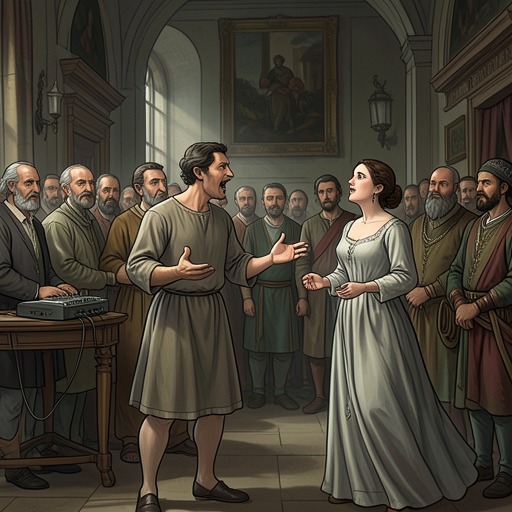
Chichibio
The DecameronChichibio is a Venetian cook whose attempt to please Brunetta leaves a bird short of a thigh and puts him at the mercy of his master, Currado Gianfigliazzi. When Currado takes him to see cranes standing on one leg, Chichibio cannot make his lie true; instead, he answers the evidence with a joke that dissolves the threatened punishment. His story makes a moment of fear into a demonstration of wit aided by fortune.
Identity and Position
Chichibio works as a good cook for Currado, a noble and generous citizen who enjoys hunting with hawks and hounds. Currado’s position gives him authority over the household and the power to punish a servant who deceives him. Chichibio is therefore not arguing with an equal: once his lie is exposed, he faces the anger of the person who employs him and controls his immediate fate.
The episode begins with Currado’s successful hunt. He sends a young, fat crane to Chichibio, instructing him to roast it well for supper. The bird is ordinary household fare, but its place at a meal shared with Currado’s guests makes the missing portion conspicuous. Chichibio’s place in the story is defined by that practical imbalance: he is responsible for preparing the meal, yet his personal attachment leads him to alter what he has been told to serve.
The Supper and the Missing Thigh
While the crane is cooking and its smell fills the kitchen, Brunetta, a young woman from the neighborhood whom Chichibio loves, comes in and asks him for one of its thighs. He initially refuses, singing his denial. Brunetta answers that if he will not give it to her, she will never again grant him anything that gives him pleasure. Rather than risk displeasing her, he cuts off a thigh and gives it to her. His choice is not presented as a calculated plan: desire for Brunetta’s favor overcomes his duty to preserve the whole bird for Currado’s table.
When the roast is served to Currado and his guests, its missing thigh draws immediate notice. Asked what became of it, Chichibio asserts that cranes have only one thigh and one leg. Currado challenges the claim from experience, but Chichibio maintains that he can show it in a living bird. Currado postpones judgment until morning, partly out of regard for his guests, and makes clear that if the claim proves false Chichibio will remember the consequences for the rest of his life. The servant’s improvisation has bought him time, not safety: the lie now requires a public test.
The Morning Test
At daybreak Currado’s anger has not faded. He has horses brought and takes Chichibio on a small horse toward a watercourse where cranes can be seen in the morning. Chichibio follows in great fear, wishing he could escape but knowing he has no way to do so. As he looks around, he interprets what he sees through the danger of the coming test; then he spots a group of twelve cranes on the bank, each standing on one leg while asleep.
Chichibio points them out as proof that he spoke truthfully. Currado approaches and calls out. The cranes put down their other legs and fly away, making their two-legged bodies plain. The demonstration has defeated the literal claim, and Chichibio is left confounded. His earlier confidence cannot withstand what Currado has just made visible; the threatened punishment seems close at hand.
Wit, Fortune, and Resolution
Chichibio’s escape comes from connecting Currado’s action to the previous night’s meal. He replies that Currado did not call out to the roasted crane as he has just called out to the birds on the bank; had he done so, it too would have put out its other thigh and leg. The answer does not repair the lie or offer a serious explanation. Instead, it turns the difference between the sleeping birds and the cooked one into an absurd extension of Chichibio’s claim, making the moment funny rather than prosecutable.
Currado laughs, his anger changes to mirth, and he makes peace with Chichibio. The resolution depends neither on proving the cook innocent nor on the master abandoning his authority in advance. Chichibio’s quick reply changes the emotional terms of the encounter at the instant when evidence has cornered him. Neifile introduces the tale by observing that fortune sometimes gives frightened people, without premeditation, a useful answer suited to their circumstances. Chichibio’s success exemplifies that idea: his first deception creates the crisis, but a spontaneous joke saves him from its consequence. The episode’s comic balance rests on the contrast between a small act of appetite, a master’s serious threat, and a servant’s brief, precisely timed turn of speech.